The Method of Deflation#
The power method finds the dominant direction. Repeating it from a different starting vector will usually find the same direction again. To find another one, we remove the component along the direction already known after every multiplication by \(A\). This is deflation.
We seek a new direction perpendicular to the known one. For a nonsymmetric matrix, eigenvectors need not be perpendicular, so this new direction need not be an eigenvector of \(A\). It will instead be an eigenvector of the projected operator, with the next eigenvalue of \(A\).
A Two-Dimensional Example#
Consider
Its eigenvalues are \(\lambda_1=4\) and \(\lambda_2=2\). Corresponding eigenvectors are \((1,0)^T\) and \(\boldsymbol{x}_2=(-1,2)^T\).
Suppose the power method has found the first unit direction exactly:
The star marks an exact basis direction, to distinguish it from numerical iterates. The orthogonal projection onto the perpendicular direction is
Projecting \(\boldsymbol{x}_2\) and normalizing gives a perpendicular unit vector:
This changes the direction: \(\boldsymbol q_{\star,2}\) is not an eigenvector of \(A\). Multiplication by \(A\) brings back a component along the first direction:
Projection removes that component:
Thus \(\boldsymbol q_{\star,2}\) is an eigenvector of \(P_1A\) with eigenvalue \(2\), the second eigenvalue of \(A\). Starting perpendicular to the first direction was not enough: we had to project again after multiplication.
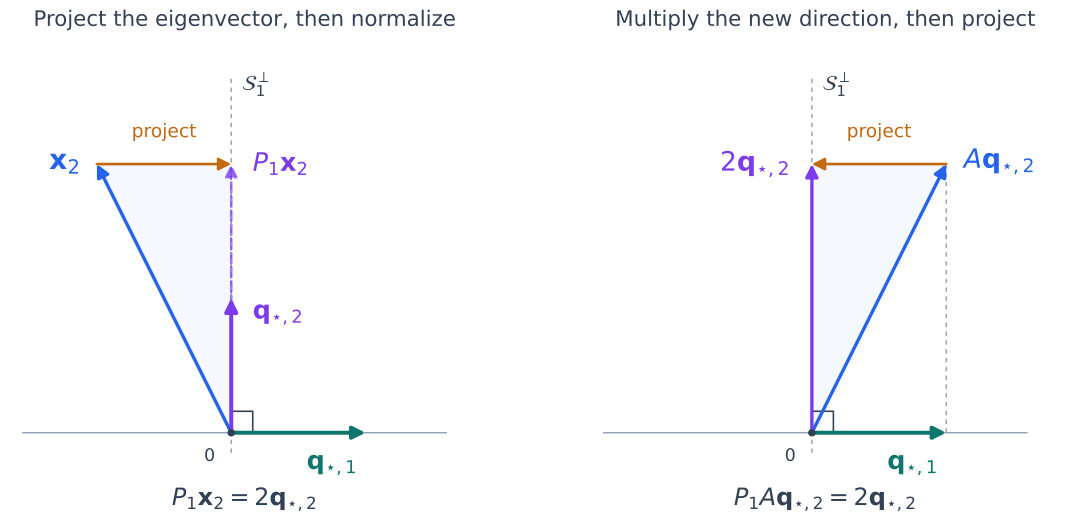
Fig. 15 Left: projection changes the eigenvector’s direction; normalization gives \(\boldsymbol q_{\star,2}\). Right: applying \(A\) to this new direction creates a component along the known horizontal direction. Removing it leaves \(2\boldsymbol q_{\star,2}\). The eigenvalue \(2\) is preserved even though the eigenvector has changed.#
Why Projection Preserves the Eigenvalue#
Suppose we have found \(i\) orthonormal directions. Collect them in
Assume that \(\mathcal S_i\) is invariant under \(A\): applying \(A\) to any vector in \(\mathcal S_i\) keeps it in \(\mathcal S_i\). This holds for the first direction because it is an eigenvector. The construction below will preserve this property as we add directions.
Let \(P_i=I-Q_{\star,i}Q_{\star,i}^H\) be the orthogonal projection onto \(\mathcal S_i^\perp\). Take an eigenvector \(\boldsymbol{x}\) with eigenvalue \(\lambda\) that is not in \(\mathcal S_i\). Split it into its known component and its perpendicular remainder:
Because the known subspace is invariant, \(A\boldsymbol{s}\in\mathcal S_i\), so \(P_iA\boldsymbol{s}=0\). Consequently,
The perpendicular remainder is therefore an eigenvector of \(P_iA\) with the same eigenvalue. Although \(A\boldsymbol{v}\) can have a component in the known subspace, its component perpendicular to that subspace is exactly \(\lambda\boldsymbol{v}\).
Invariance also gives
The first identity says that \(P_iA\) sends every vector in the known subspace \(\mathcal S_i\) to zero.
Why the New Directions Are Schur Vectors#
For the sequential construction, order the eigenvalues so that
They are distinct, so their eigenvectors \(\boldsymbol{x}_1,\ldots,\boldsymbol{x}_n\) are independent. Suppose that \(\mathcal S_i\) spans the first \(i\) eigenvectors. Projecting the next one gives
The denominator is nonzero because \(\boldsymbol{x}_{i+1}\notin\mathcal S_i\). This describes the direction we want; the algorithm below finds it without knowing \(\boldsymbol{x}_{i+1}\).
Since \(P_i\) retains the perpendicular component, the last identity means
Therefore, adding this direction gives a larger invariant subspace. It is also the span of \(\boldsymbol{x}_1,\ldots,\boldsymbol{x}_{i+1}\), because we have only subtracted a vector in \(\mathcal S_i\) from \(\boldsymbol{x}_{i+1}\) and normalized.
Starting with the first eigenvector and repeating this construction produces an orthonormal basis. In that basis, each column satisfies
Only earlier directions and the current direction occur. Collecting the columns gives
where \(Q_\star=[\boldsymbol q_{\star,1},\ldots,\boldsymbol q_{\star,n}]\) is unitary and \(T\) is upper triangular. This is the Schur decomposition.
The off-diagonal entries of \(T\) record the components along earlier directions. They explain why a Schur vector need not be an eigenvector of \(A\). The diagonal entries still give the eigenvalues of \(A\), and orthogonality gives
For Hermitian matrices, the eigenvectors can be chosen orthonormal, and these Schur directions are eigenvectors of \(A\) itself.
The Spectrum After Deflation#
The geometric argument identifies the next direction. We must also check that it is dominant for the projected operator, so that power iteration can find it. The following result gives the full spectrum after projection. It holds for any ordered Schur decomposition, without the strict-gap or nonzero-eigenvalue assumptions above.
Theorem 24 (Exact Schur Deflation)
For \(1\le i<n\), let \(P_i=I-Q_{\star,i}Q_{\star,i}^H\) and \(M_i=P_iA\). The eigenvalues of \(M_i\) are \(i\) zeros followed by \(\lambda_{i+1},\ldots,\lambda_n\), counted with multiplicity. Moreover,
Proof. Deflation in Schur Coordinates. Partition the Schur form after its first \(i\) rows and columns:
In Schur coordinates, \(P_i\) sets the first \(i\) components to zero:
This upper triangular matrix has the claimed diagonal entries. The first column of \(T_{22}\) has \(\lambda_{i+1}\) at the top and zeros below. Thus its first coordinate direction is an eigenvector; transforming back to the original coordinates gives \(\boldsymbol q_{\star,i+1}\).
Power Iteration on the Remaining Subspace#
Under the strict magnitude ordering above, \(\lambda_{i+1}\) is the unique dominant eigenvalue of \(M_i\). Choose a random vector \(\boldsymbol{g}\) and initialize
Redraw if the projection is zero. For fixed \(i\), repeat
Each step multiplies by \(A\), subtracts the component in the known subspace, and normalizes. There is no need to form either \(P_i\) or \(M_i\). Here \(i\) counts known directions and \(\ell\) counts power iterations for the next direction.
As in the power method, \(\boldsymbol v_0\) must have a nonzero coefficient in the dominant direction when expanded in an eigenvector basis of \(M_i\). Projecting a random vector drawn from a continuous distribution satisfies this condition, and gives a nonzero initial projection, with probability one in exact arithmetic.
Then the line spanned by \(\boldsymbol v_\ell\) converges to the line spanned by \(\boldsymbol q_{\star,i+1}\). For \(i\le n-2\), the geometric convergence factor is governed by \(|\lambda_{i+2}/\lambda_{i+1}|\). After \(n-1\) directions have been found, their one-dimensional orthogonal complement supplies the last direction without further power iteration. Signs or complex phases do not affect these subspaces.
This construction assumes the preceding directions are exact. In computation, they are still approximate. Orthogonal iteration updates all directions together, using QR to perform the successive projections. There, \(Q_k\) denotes the basis at iteration \(k\), while \(Q_\star\) remains the exact Schur target. Equal eigenvalue magnitudes may require following several directions as a subspace rather than one direction at a time.